
 BOULEVARD LIGHTING PROJECT
Choose a topic below, or select Expand All to read the full guide.
01Understanding LightLumens, lux, color temperature, and light distribution
The vocabulary of light
Total visible light emitted by a source. Lumens alone do not tell you where that light lands.
Illuminance on a surface: one lumen per square meter. Our DIALux lighting-design software sidewalk results are reported in lux.
Illuminance measured in lumens per square foot. 1 fc ≈ 10.76 lux.
Electrical power consumed, not a measure of light delivered. Optics and efficiency matter.
Correlated color temperature describes warm or cool appearance: lower Kelvin looks warmer; higher looks cooler.
How evenly illumination is distributed. A bright average can hide very dark areas between fixtures.
Warm and cool light
Color temperature changes how light looks, not how bright it is. We are studying warmer 3000–3500 K light instead of the 6000 K light offered in some solar options.
Illustrative gradient only; actual perceived color depends on the fixture, surroundings, and display.
02Fixture DesignNeighborhood lighting examples, pole components, and fixture styles
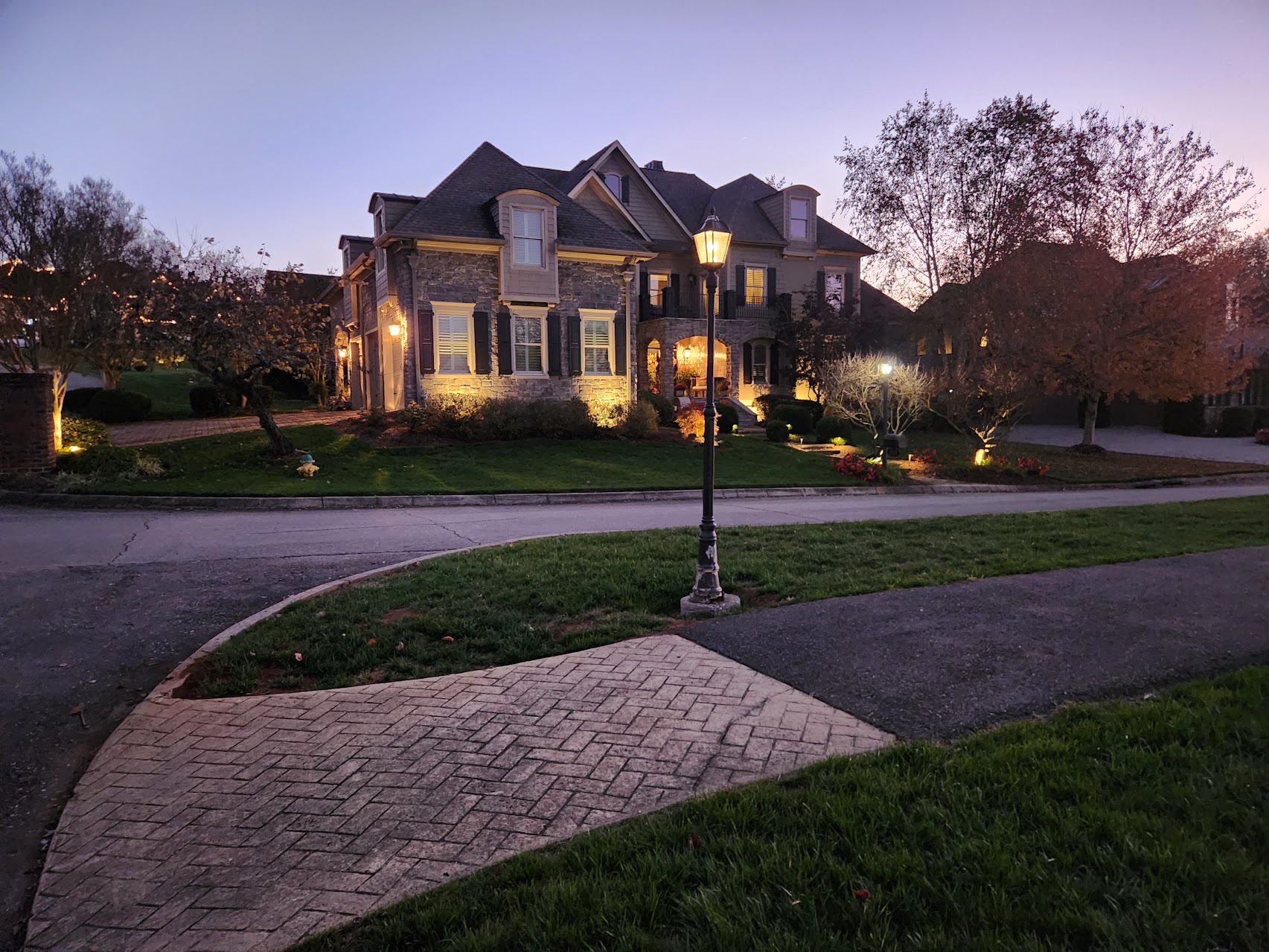
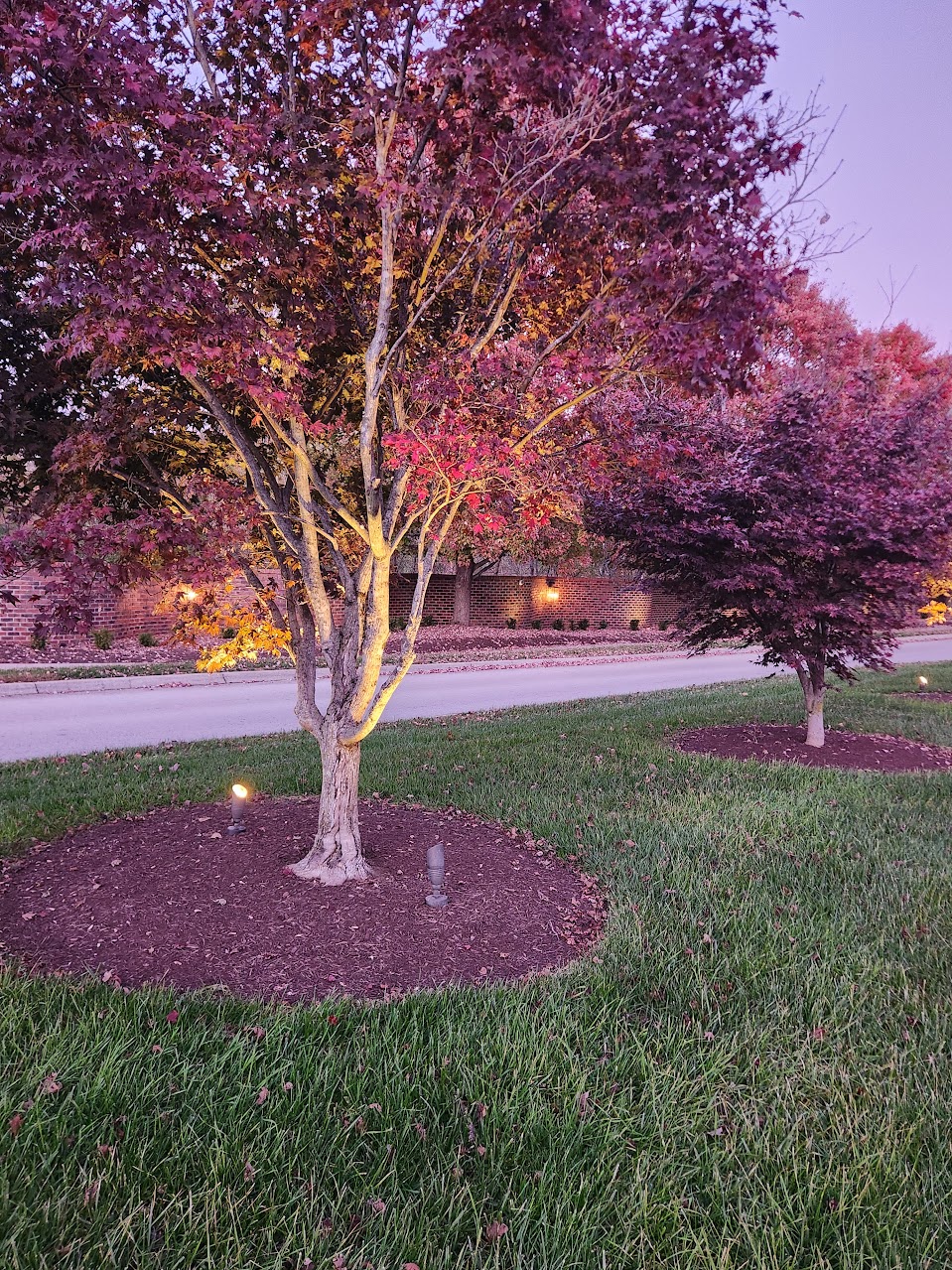
Lighting already present in Jefferson Park
These photographs show how pathway, landscape, architectural and entrance lighting can complement boulevard lighting.
Anatomy of a boulevard light
A complete installation is a decorative post-top lighting assembly, not just a lamp. The components can be specified separately, but their dimensions, mounting interfaces, electrical ratings and structural requirements must be compatible.
Usually a reinforced concrete pier with embedded anchor bolts and electrical conduit. Exposed height, depth and diameter depend on site and engineering requirements.
Available in aluminum, steel, concrete and composite materials. Height, shaft diameter, taper, finish and wind-load rating affect both appearance and cost.
Also called an ornamental base, shroud or anchor-bolt cover. Some designs have an integral decorative base; others use a separate cover.
The LED light-producing unit. Its optics, shielding, output, color temperature, serviceability and appearance determine much of the lighting experience.
Selection principle: Components may come from different manufacturers, but the designer must verify mechanical fit, electrical compatibility, pole/fixture wind loading, foundation design and local installation requirements.
Common outdoor lighting fixture styles
These photographs illustrate different architectural styles, not selected products or measured lighting performance. Appearance alone does not determine light distribution, glare, or suitability for the boulevard.
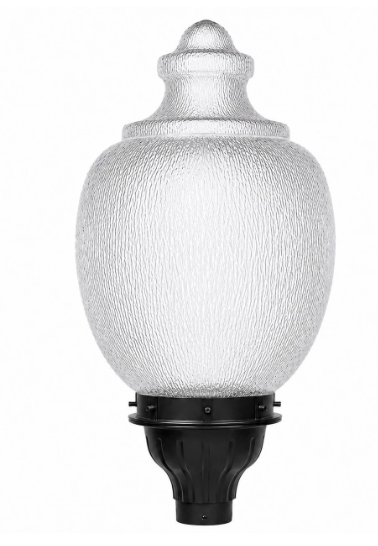 Acorn
Decorative acorn-shaped diffuser; available optics and shielding vary.
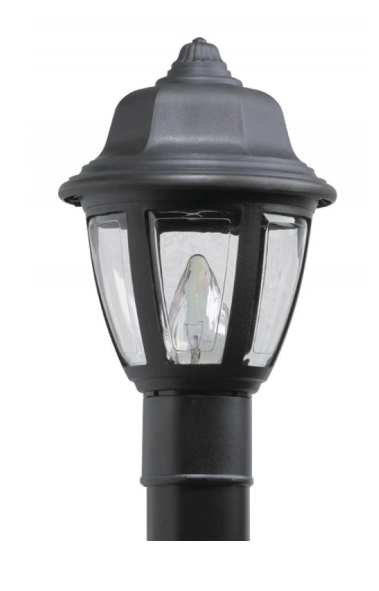 Lantern
Traditional lantern-style architectural housing.
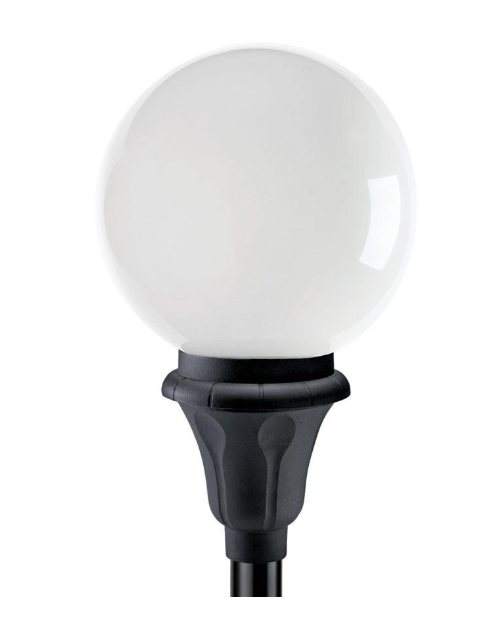 Globe / ball
Round globe profile; light control depends on internal optical design.
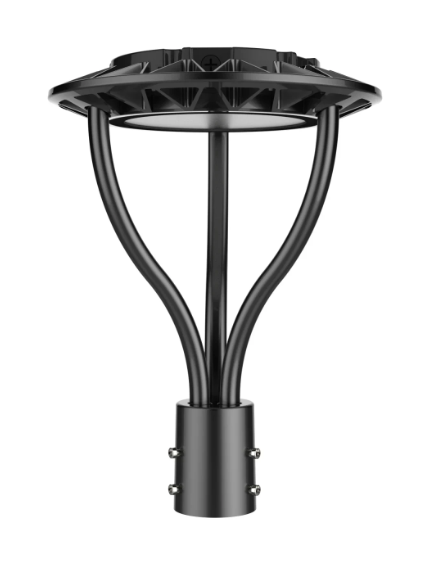 Contemporary
Modern open-frame post-top design with a different visual character.
Pole design variables
Aluminum is corrosion-resistant; coated steel offers strength; concrete and composites offer other aesthetic and durability tradeoffs.
Both influence scale, stiffness and foundation loads. A taller or wider pole is not automatically better.
Smooth, tapered, fluted, round or square shafts; painted, powder-coated and other finishes.
Photographs supplied for Jefferson Park homeowner education. Fixture selection and lighting performance remain under evaluation.
Jefferson Park entrance wall — local architectural context
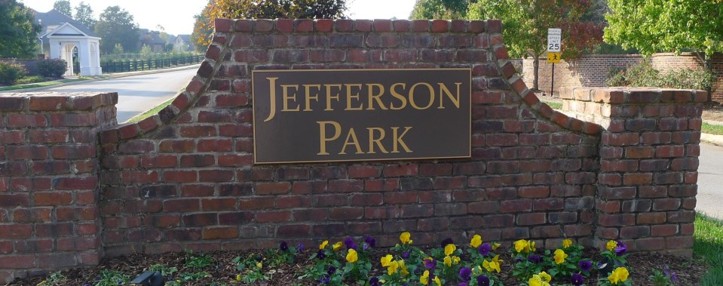
Our entrance walls and landscaping are part of the neighborhood’s nighttime identity. Coordinated architectural and pathway lighting can complement one another; this daytime photograph is a location reference, not a lighting demonstration.
03Pole Height & SpacingOptics and the interactive boulevard pole-height comparison
Pole height, spacing and optics
Raising a light source can broaden the area reached, but it can also reduce illuminance directly beneath it if all other factors are unchanged. Lens distribution, shielding, output, and placement are just as important as pole height.
Conceptual footprints, not calculated coverage. The Gama study used 6.5-foot posts; the preliminary AC modeling uses 12-foot posts and a roughly 175-foot spacing reference.
Two fixtures with the same lumens can produce very different sidewalk readings. IES (Illuminating Engineering Society) photometric files and DIALux layout software help show the difference before construction.
Jefferson Park boulevard — pole-height comparison
Select a nominal luminaire mounting height to compare its visual scale against the boulevard. The drawing uses the project reference dimensions of two 20-foot roadways and a 6-foot sidewalk in the median. The median width is illustrative and has not been verified. The pole is shown in the planted median beside the sidewalk, with a 6-foot person for scale.
12-foot mounting height — current AC design reference
The height selector changes the pole drawing only. It does not calculate light spread, lux, glare, or fixture spacing. Actual height is measured to a defined luminaire mounting point and may differ from the nominal pole shaft length or total assembly height.
04Evaluating PerformanceAverage and minimum lux, project charts, IES files, and DIALux
What average and minimum lux tell us
| Preliminary model | Average sidewalk | Minimum sidewalk |
|---|---|---|
| Gama F1 (single head) | 0.62 lux | 0.022 lux |
| Gama F2 (two heads) | 1.20 lux | 0.042 lux |
| Atlas AC, 70W | 2.68 lux | 0.019 lux* |
*The Atlas overall minimum may be outside the pole-to-pole interval. Visible points near the modeled 175-foot midpoint were approximately 0.15–0.16 lux. Model geometry differs between alternatives; these are design comparisons, not controlled fixture-only tests.
The solar single-head model is a useful approximation for reduced light output, but it is not a verified simulation of the manufacturer's dimming schedule. No model is presented as meeting a particular lighting standard.
How to read our project charts
Our charts report predicted illumination from DIALux calculations. They are not nighttime photographs or verified field measurements. Higher average lux can improve visibility, but low minimum values indicate darker areas remain.
The colored nighttime sample markers on the project map show relative differences only. Their readings have not been fully validated, and the colors do not establish compliance with any lighting standard.
Learn more: IES files and DIALux
IES — Illuminating Engineering Society: A professional organization providing lighting standards, recommended practices and technical guidance. An IES photometric file describes measured light distribution from a particular fixture, which helps designers predict where its light will fall.
DIALux: Lighting-design and calculation software that uses photometric files together with site geometry, mounting height and spacing to predict light levels on sidewalks and roadways.
How they work together: IES fixture data → DIALux site model → predicted illumination (lux). These are predictions, not field measurements or proof of compliance with a standard.
Official resources: Illuminating Engineering Society · DIALux.
05Installation & MaintenanceInstalled cost considerations, solar and AC maintenance
Why installed costs vary
Decorative outdoor lighting is not a single-price product. Basic components may cost a few hundred dollars, while premium architectural poles or luminaires can cost several thousand dollars each, even before installation.
| Cost element | What drives the price |
|---|---|
| Luminaire | Optics, materials, LED/driver quality, controls, finish, warranty and replacement-part support |
| Pole and decorative base | Material, height, diameter, taper, ornamental details, finish and structural rating |
| Foundation | Soil conditions, height above grade, reinforcement, excavation, anchor-bolt layout and site restoration |
| Electrical infrastructure | Trenching distance, conduit, wiring, power availability, controls and roadway/landscape restoration |
| Lifetime upkeep | Energy, cleaning, batteries where applicable, drivers, replacement components and labor access |
Project status: Jefferson Park has not selected or approved a complete lighting assembly. Site-specific quotations and engineering are needed before meaningful installed-cost comparisons can be made.
Solar and AC-powered maintenance
Check solar-panel cleanliness and exposure, battery capacity and aging, control electronics, LED modules, pole condition, and replacement-parts availability. Winter weather and shade can affect charging.
Inspect electrical connections, drivers, surge protection, LED modules, poles and foundations, and any underground circuits. Energy and utility costs continue during operation.
Both systems need maintenance. We need to compare installation, repairs, and replacement—not just fixture prices. Actual service life will depend on conditions and warranties.