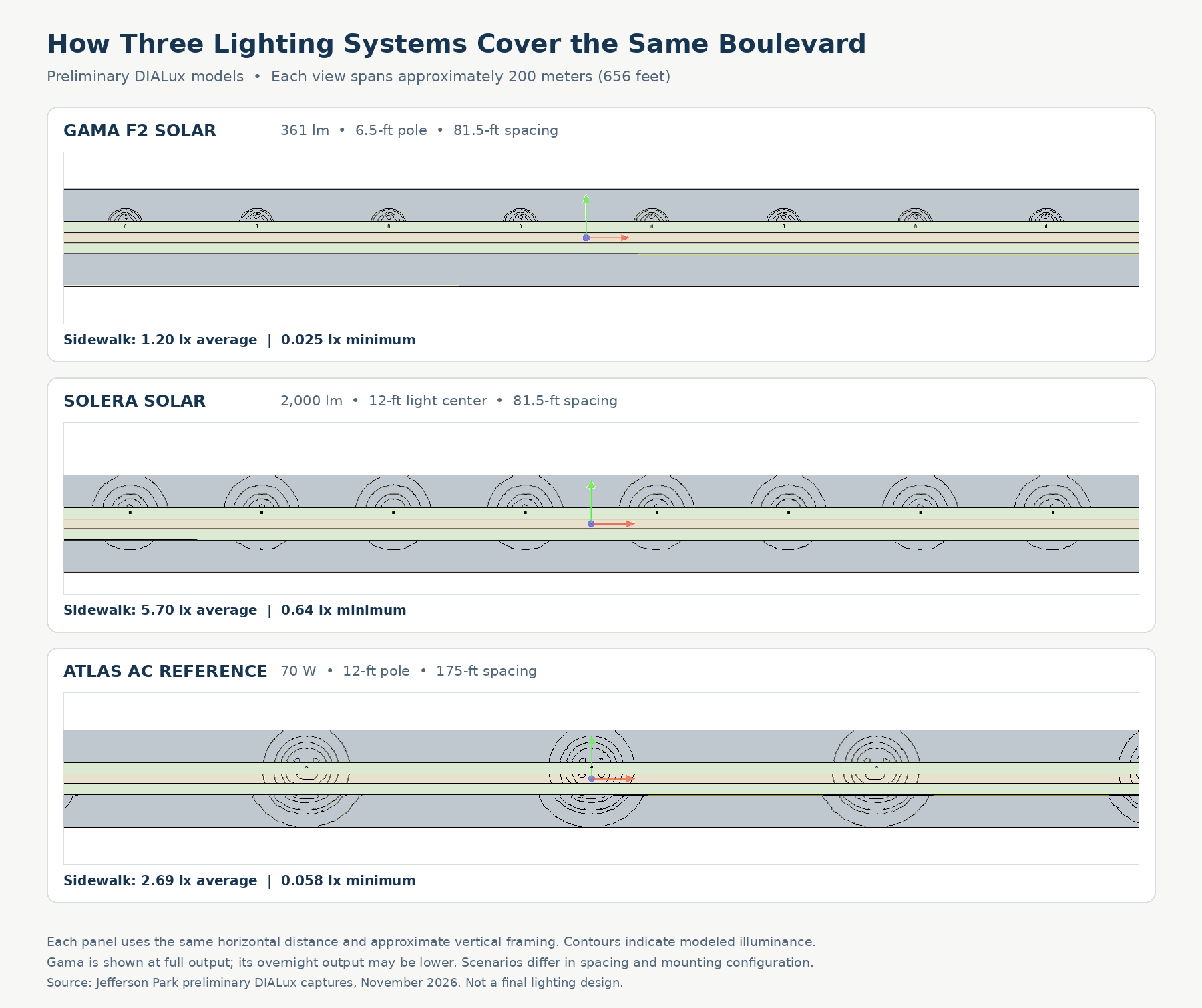
Three approaches under review. Start with the findings below, or open each fixture's technical details to see the supporting calculations.
How to read the models: DIALux uses manufacturer photometric data (IES files) to predict how light reaches sidewalks and roads. Lumens (lm) measure light produced by a fixture; lux (lx) measures light reaching a surface. The modeled layouts differ in pole height and spacing.
Note: The existing pole spacing averages approximately 76 feet; the Gama and Solara DIALux examples shown below use 81.5-foot modeled spacing. The results are therefore illustrative, not a point-by-point reproduction of every existing pole location.
These are preliminary assessments, not final engineering recommendations. The DIALux scenarios use different spacing and mounting arrangements.
01 · Solar
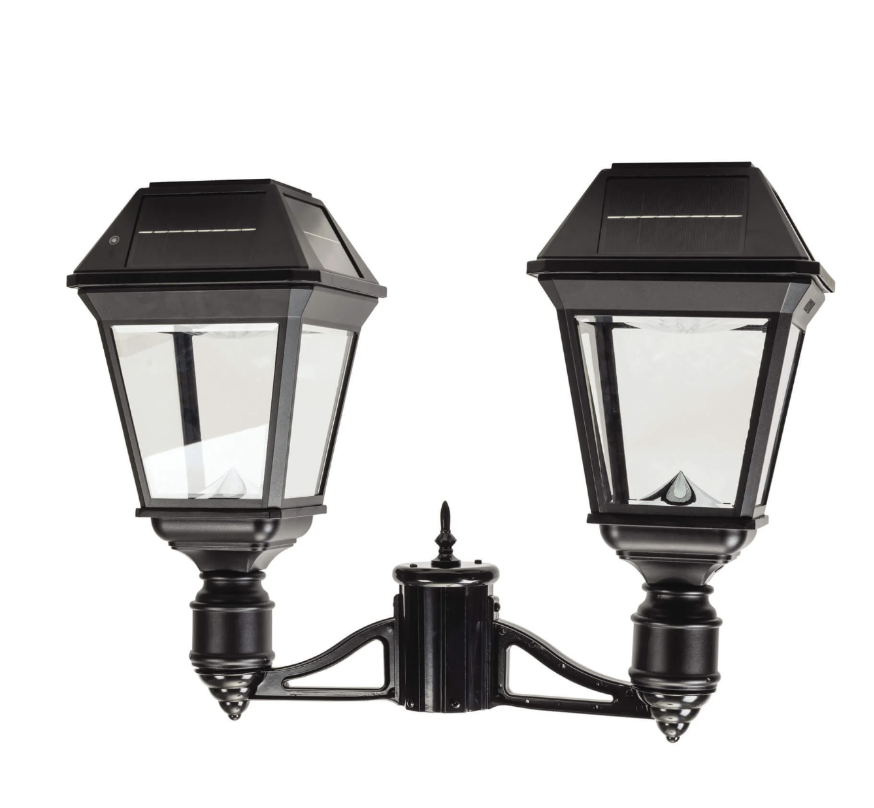
Gama F2
361 lmIES model output
2,700 KSelected CCT
6.5 ftExisting pole
Solar + batteryTechnology
Jefferson Park assessment
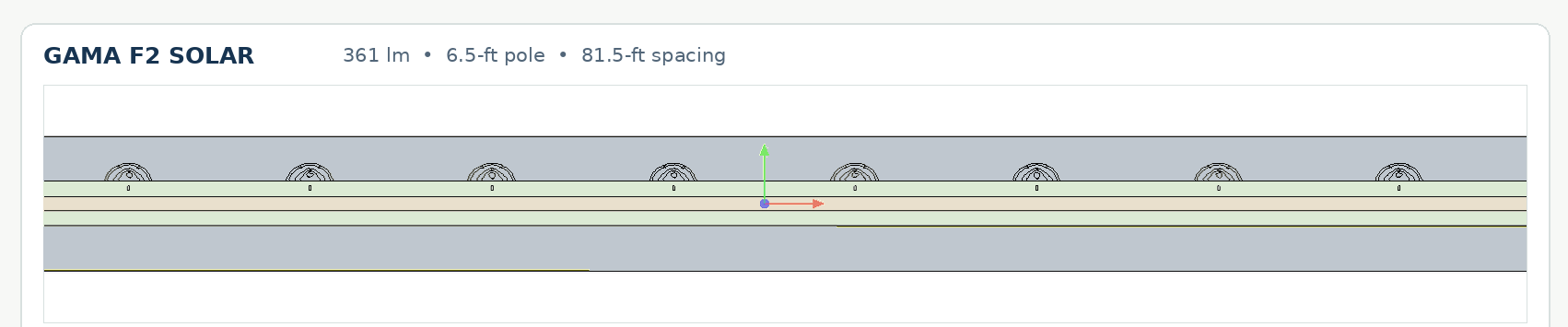
Coverage: Significant sidewalk and roadway gaps at existing spacing.
Height: At 10 ft, modeled minimum sidewalk illuminance improves about 176% (0.025 to 0.069 lux); average changes from 1.20 to 1.13 lux. Dark areas remain.
Nighttime: Full output for four hours, then approximately 50%.
DIALux at full output · 6.5-ft pole · 81.5-ft spacing · 1.20 lux average sidewalk illumination. Click to enlarge.Technical details · Battery and modeling
Nominal battery capacity: 76.8 Wh; solar panel capacity: 16 W for the dual-head configuration (subject to configuration verification).
This idealized calculation excludes losses, battery aging, controller demand and incomplete charging; actual output follows the programmed sequence.
At 10 ft, minimum sidewalk illumination rises by approximately 176%, but average illumination is about 6% lower. These are different performance measures.
F1 photometric information may be used internally to approximate reduced F2 output; F1 is not a proposed fixture.
02 · Solar
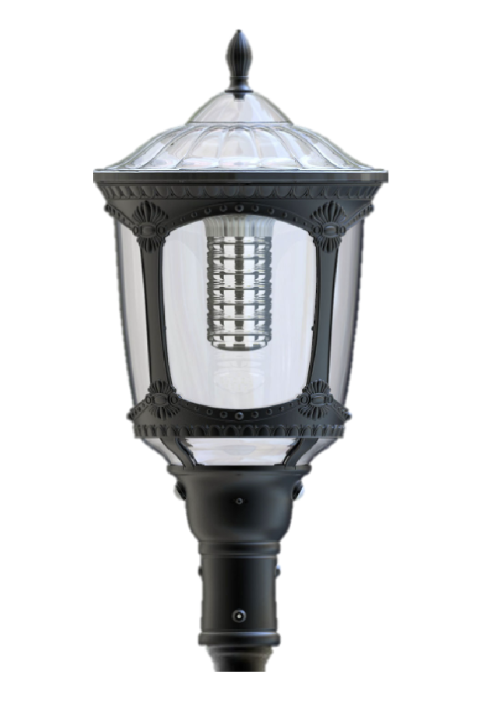
Solara
2,000 lmRated peak output
2,700 KSelected CCT
12 ftModeled height
Solar + motionTechnology
Jefferson Park assessment
Coverage: Full-output model shows substantially higher sidewalk illumination than the existing Gama arrangement.
Nighttime: Programmed operation is primarily 10–35% output; motion can trigger 100% for 30 seconds.
Decision point: Assess normal dimmed illumination—not just the 2,000-lumen peak.
User experience: Changes in brightness triggered by nearby movement may be noticeable to pedestrians, drivers, and residents. Jefferson Park has not determined whether this operating sequence is acceptable.
DIALux at 2,000-lm output · 12-ft modeled height · 81.5-ft spacing · 5.70 lux average sidewalk illumination. Click to enlarge.Technical details · Operating modes and battery
Battery: 88.8 Wh; solar panel: 12.5 W; rated LED: 20 W.
Mode 1: 5 hours at 35% light output, then 7 hours at 10%.
Mode 2: 5 hours at 30%, then 5 hours at 10%, then 2 hours at 20%.
Percent light output is not necessarily equal to percent electrical power consumption without measured test data.
Full output: Motion activation raises output to 100% (2,000 lumens) for 30 seconds, then returns to the active programmed level. Neither timed mode operates at 100% continuously.
03 · AC-powered
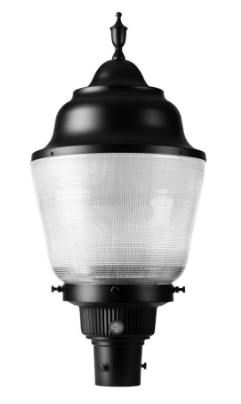
Atlas ACNS · Modeling Reference
6,792 lmRated output
3,000 KCCT
12 ftModeled pole
70 W ACTechnology
Jefferson Park assessment
Coverage: Preliminary model evaluates wider, approximately 175-ft spacing.
Operating sequence: Photocell ON at dusk, OFF at dawn. No programmed reductions in light output during the night.
Infrastructure: Requires AC wiring and circuit routing; evaluate installation cost, maintenance, and final optics.
DIALux · 12-ft pole · 175-ft spacing · approximately 2.68–2.69 lux average sidewalk illumination. Click to enlarge.Technical details · Model assumptions
ACNS 70-W IES reference, 3,000 K, CRI ≥80.
Control strategy: Photocell-controlled dusk-to-dawn operation at constant output, with no scheduled dimming or motion activation.
Fixture choice is not final; pole and wiring design remain preliminary.
The modeled spacing differs from both solar cases, so average lux values are not controlled fixture-only comparisons.
Atlas model maintenance factor and sidewalk boundary effects require verification before final design.
Compare the three layouts
All three views use the same approximate 200-meter horizontal window. The spacing, mounting and operating assumptions differ. Solar views show maximum output, not necessarily sustained nighttime output.
Click the image for the full-size comparison. Model outputs are predictions, not measurements of installed nighttime performance.

 BOULEVARD LIGHTING PROJECT